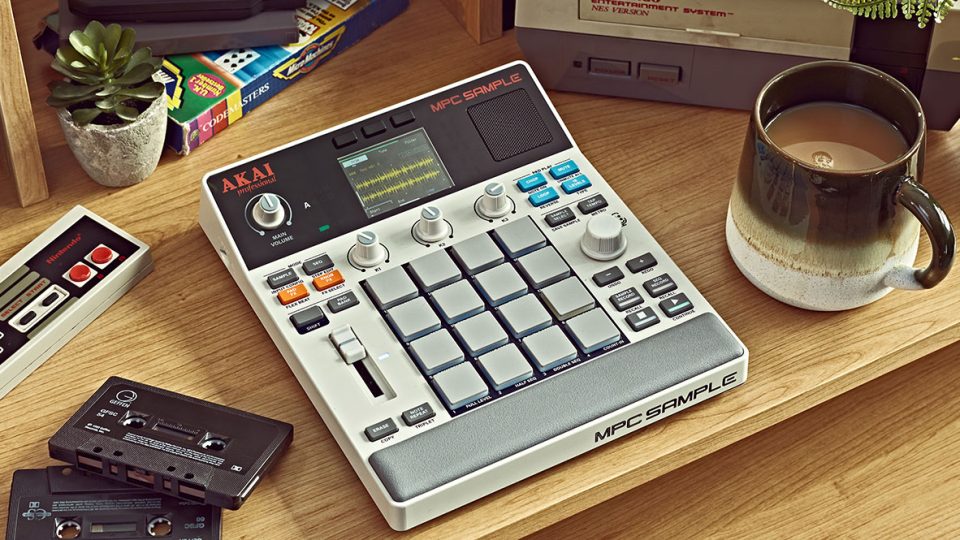
Could the Akai MPC Sample become the best selling sampler….ever?
Only a few weeks back we bought news of a new MPC on the horizon. At this point details were scant, with many even speculating that it could be a hoax or the work of AI tricksters.
Fast forward to now, and the MPC is firmly a reality…but nobody could have predicted the amount of noise this little device would make (and I’m not talking about the output of it’s 3w speaker) In fact, if there were an award for the most hyped piece of music gear so far in 2026, Akai already have it in the bag.
As a middle-aged, sample-based Hip-Hop producer, I’ll be honest, I am the MPC Samples algorithmic dream, but even so, I can’t remember a time where my feed was so completely monopolised by a single piece of gear. And it’s not just the usual discussions and debates, though there’s plenty of those. My timelines are flooded with unboxing shots, first impressions, initial demos and proud new owners showing off their latest MPC purchase. So it’s safe to say, this unit is selling like hot ‘sampled’ cakes.
Clearly, Akai has struck gold. But what is it about this machine that’s capturing the producer community’s attention in such an overwhelming way?
The MPC legacy
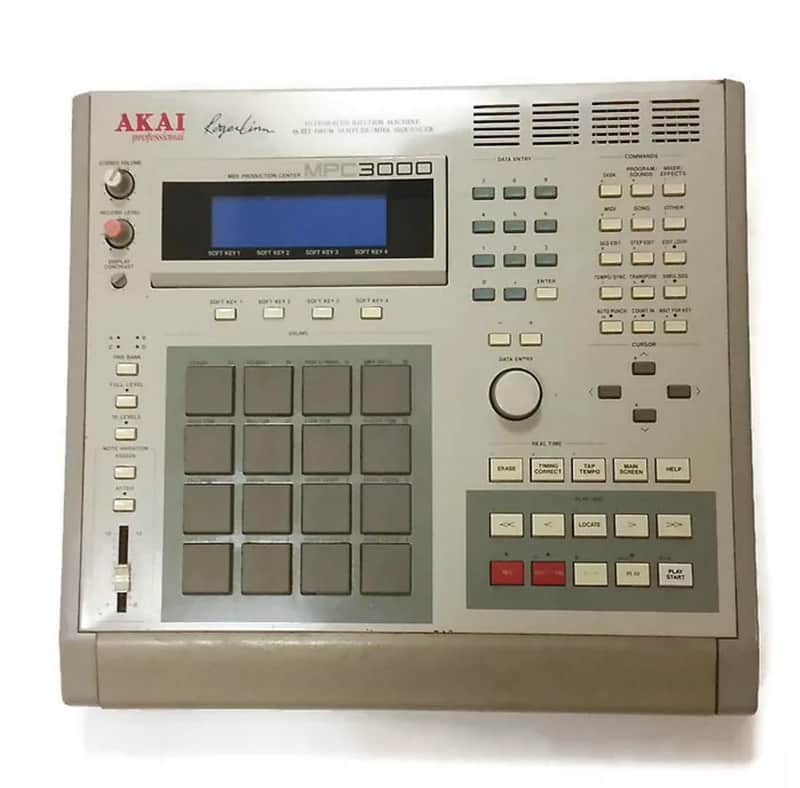
Before discussing this new release in more detail, it’s worth acknowledging the heritage it comes from. The MPC Sample is the latest in a long lineage dating back to 1988 with the launch of the MPC60. The Sample is, in fact the 21st machine to bear the MPC title.
Designed by Roger Linn, the master mind behind the LinnDrum, the MPC 60 helped reshape music production. At a time when samplers were still rare, its hands-on workflow quickly attracted producers across many different genres.
By the release of the MPC3000, the MPC had become synonymous with hip-hop production, its pad-based sequencing defining a new way of making music. The iconic late producer J Dilla, cemented the MPC’s reputation as a hip-hop weapon of choice.
Since then, the MPC has come to represent an alternative way of working, establishing itself as the most recognisable example of the groovebox. And with the buzz surrounding the MPC Sample, it’s clear this way of working is far from extinct.
Added Sample appeal
So what is it that has made this particular MPC ignite such enthusiasm and passion within the producer community?
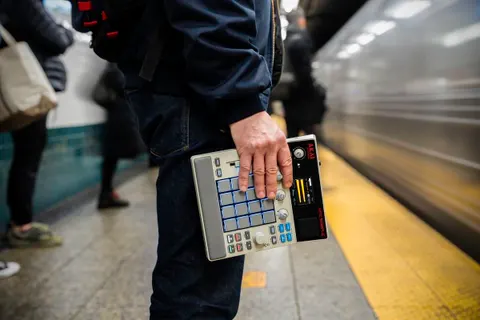
First, at £339 the price point places it within an accessible bracket for many aspiring as well as established beatmakers. Then there’s the portability. The unit is compact enough to slip into a small tote bag, or even a large pocket, making it genuinely portable in a way many other devices aren’t. Add to that battery power and a built-in speaker, and it starts to represent an untethered ideal: the ability to step away from the confines of a studio. Romanticised dreams of making beats on a train commute, or even knocking out a banger sat shaded by a giant oak tree in the middle of a summer meadow, come to mind.
But more than this, it just looks like a fun device to use. Its disarmingly cute looks strongly reference the MPC60 and MPC3000. The MPC Samples retro styling makes it, arguably, about as approachable and visually appealing as it’s possible for music gear to get. It certainly doesn’t look intimidating or overly technical.
Equally important is what it represents. For many, this feels like Akai returning to its roots by delivering a machine that leans more toward a dedicated standalone sampler than a DAW in disguise. It suggests a tool capable of professional-grade production without being weighed down by excessive features. At its core, it’s built around sampling, chopping, and sequencing, and for sample-based producers, that focus is exactly what they have been waiting for.
Feature list
While the MPC Sample comes in at an entry-level price point, it feels as though it is punching up in terms of spec. Here are the main featured specifications:
- Storage Capacity 8GB internal (*Including ~2GB factory data), microSD expansion
- RAM 2GB
- 16 RGB Velocity-Sensitive MPC Pads with polyphonic aftertouch
- Polyphony 32 Stereo Voices
- Internal Storage: 8 GB eMMC
- microSD Card Expansion Slot
- 2.4″ Full-Color LCD Display with waveform editing
- MPC Sequencer with Real-Time Swing (960 PPQN)
- Instant Sample Chop Mode
- Real-Time Time Stretch & Repitch
- Built-In Effects — multiple engines (Pad FX, Knob FX, Flex Beat, Colour Compressor with ~60 types)
- Rechargeable Lithium-Ion Battery (~5–6 hours)
- Built-in Speaker (3 W)
- Internal Microphone for quick sampling
- USB-C Port (power, audio I/O, MIDI, file transfer)
- Audio Inputs: Stereo 1/4″ TRS
- Audio Outputs: Stereo 1/4″ TRS
- MIDI In/Out (via 1/8″ TRS with adapter)
Who is the target market?
So, we’ve already established that this unit is generating a significant amount of attention within the producer community, but who exactly are Akai targeting with the MPC Sample?
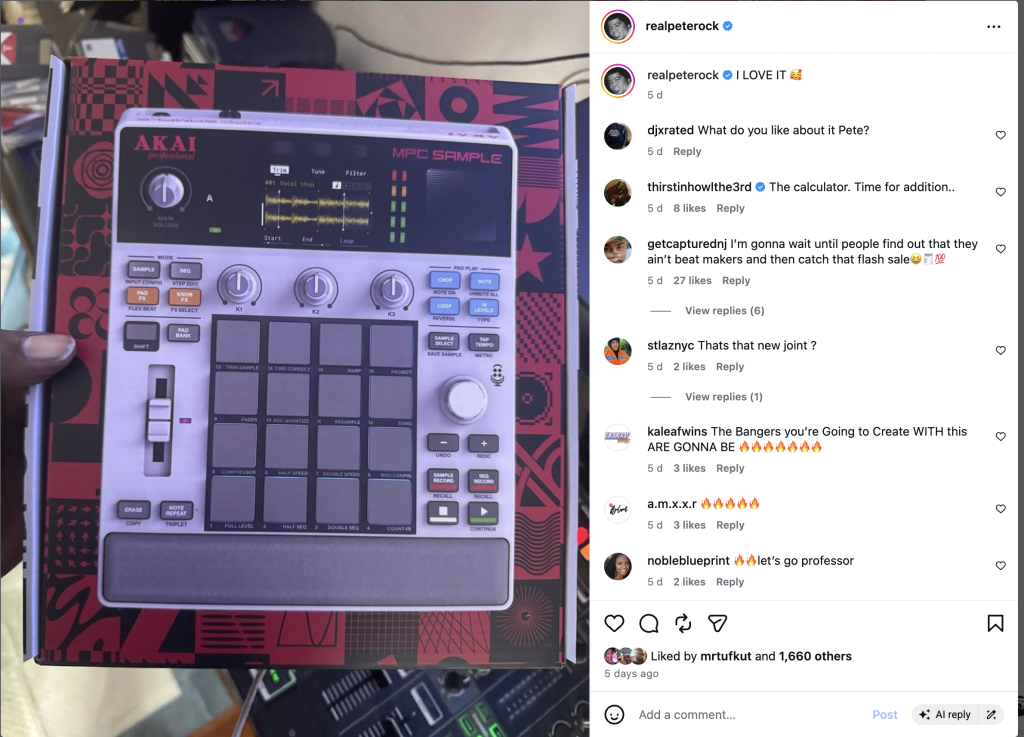
The traditional boom-bap style of Hip-Hop production with it’s heavy reliance on sample-driven beat making makes this the primary target market for the MPC Sample. And this is certainly backed up by the feverish levels of engagement on my hip-hop skewed socials. Even big-name Hip-Hop producers like Pete Rock, SkiBeats and Hi-Tek have been sharing clips of themselves cooking up bangers on the MPC Sample. It’s unclear whether Akai has provided them with the device, but their use of it stands as a powerful endorsement all the same.
That said, its appeal clearly extends beyond just hip-hop. It appears to resonate with anyone who works with samples and grooves but has grown tired of staring at screens. Many producers can feel overwhelmed by the near-limitless possibilities that DAWs provide and crave a more direct, intentional production method. I’ve seen producers across a wide range of genres discussing this sampler, from house and broken beat to jungle and breakbeat.
At the same time, the continued demand and rising prices for classic vintage samplers like the SP-1200 and early MPCs highlight a broader shift back toward hands-on, tactile workflows. Recent successes such as Teenage Engineering EP-133 K.O. II and the Roland SP-404MKII further reinforce the appeal of standalone, portable devices that prioritise simplicity and immediacy.
In this context, Akai has positioned the MPC Sample right between these two in terms of price point. Unsurprisingly, this has led to plenty of comparisons across all three devices.
That said, Akai arguably holds the upper hand when it comes to its undeniable heritage. The MPC name still carries significant weight, and when its newest incarnation draws such clear inspiration from the much-mythologised MPC3000 you know interest will be high.
A golden year for Akai
But could the MPC Sample become the best-selling sampler of all time?
It’s hard to recall another piece of music hardware that has generated this level of hype and demand on launch. A quick search suggests that, at least in the UK, units are currently unavailable from retailers, with many dealers instead taking pre-orders and quoting delivery times of several weeks. This current scarcity has even led to units appearing on marketplaces at significantly inflated prices. At the time of writing, listings for the MPC Sample on eBay have reached around $699.99, which is $300 more than the RRP!!!
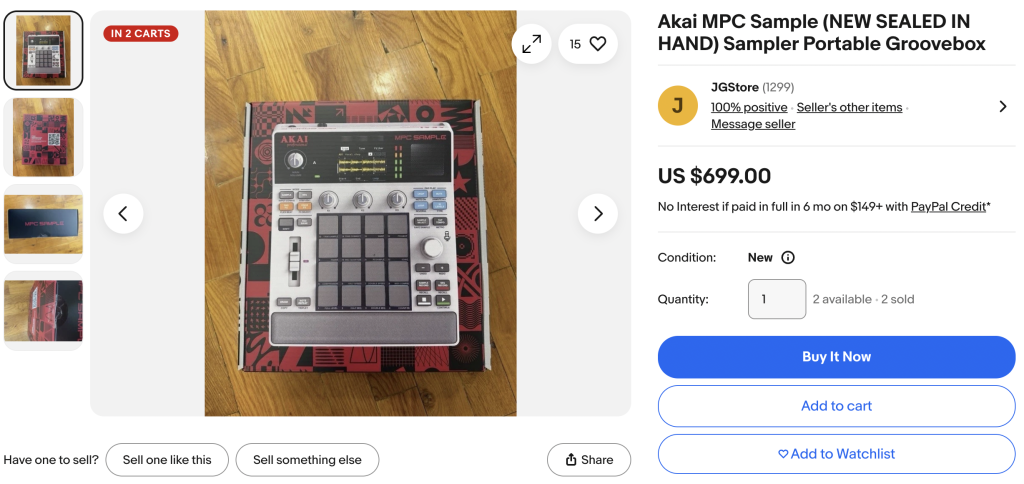
It will be interesting to see how this unfolds and whether Akai has genuinely struck gold with this release. Could they potentially have a product on their hands with a similar trajectory to the Korg microKORG, which, since its release in 2002, has become one of the most commercially successful and widely adopted instruments of its kind. It certainly shares many of the traits of the microKORG in that it’s a compact, affordable and aesthetically pleasing version of a desirable vintage product.
Much of this momentum is likely to build organically as producers begin sharing beats, demos, and tutorials using the machine, effectively doing a large portion of the marketing themselves.
And finally, as we wrap this piece up, it would be remiss not to mention that at RouteNote Create, we offer a fitting companion for any newly acquired sampler. Whether it’s the MPC Sample or any other device, we offer a cost-effective platform where you can discover the perfect samples for your beats. Sign up to dive into its full catalogue.