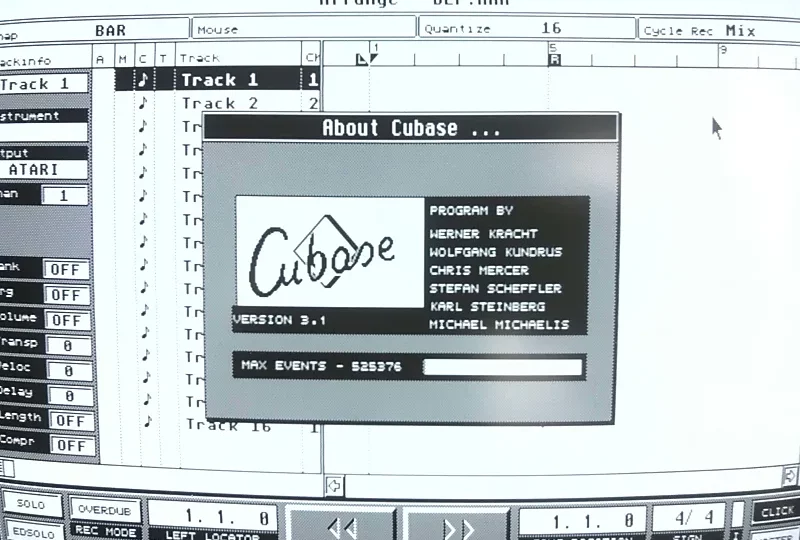
Atari St + Cubase: A 20th Centuary DAW Setup
We take modern music production for granted these days. Everything happens in the box: unlimited tracks, instant editing, endless plug-ins. But if you rewind to the previous century, things looked very different.
This post is inspired by the launch of Cubase 15 as well as a fantastic video from YouTuber Dan Baxter, who takes us on a nostalgic trip back to a late 1980s digital audio workflow, that just about works but has much less in the way of flow.
1980s and the Birth of MIDI

One of the biggest breakthroughs that pushed music into the digital age was the creation of a universal communication standard for electronic instruments called MIDI (Musical Instrument Digital Interface).
Once MIDI became the norm, it suddenly became possible to sync synthesisers, drum machines, sequencers, and recording devices seamlessly. And it was computer company Atari’s forward-thinking move to add built-in MIDI ports to their computers that made the Atari ST the natural choice for musicians everywhere.
While other computers, like the Apple Macintosh or IBM PCs, could handle music tasks, they were often clunky and expensive. The Atari ST (and its competitive cousin, the Commodore Amiga) stood out as one of the first personal computers with a graphical user interface (GUI), something essential for running what we’d now call a digital audio workstation (DAW).
And among the early music software, one name quickly rose to the top: Cubase.
Cubase: A Whole New World of Compositional Control
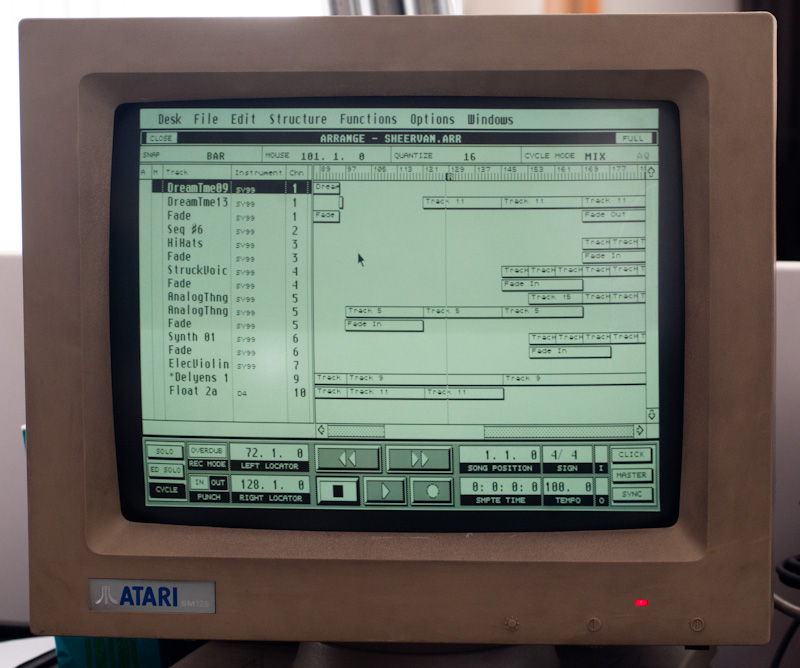
MIDI hardware sequencers and drum machines were everywhere in the ’80s, but Cubase introduced a visual, timeline-based approach that ran on an affordable home computer. This changed everything.
On the Atari ST, which maxed out at just 1 MB of RAM, Cubase was primarily used to sequence and control external MIDI instruments rather than produce audio internally. Still, the resemblance to today’s workflows is unmistakable. For example, It uses a horizontal timeline, MIDI blocks representing notes, and an editable “Key Editor” window.
In Dan Baxter’s video, you can see how many familiar modern DAW concepts, like keyboard shortcuts and track editing views, actually originated with these very early versions of Cubase running on the Atari ST.
Full Integrated MIDI Setup

It’s important to remember that the Atari ST + Cubase combo wasn’t a full-fledged DAW like we’re used to today. Although the ST had a Yamaha YM2149F sound chip with a simple 3-voice square wave + noise channel, its limited memory and processing power meant it wasn’t used for actual audio recording or effects.
Instead, it functioned primarily as a sequencer, with everything connected via MIDI cables, with synchronisation handled through MIDI Time Code or SMPTE. As shown in the video, this setup was miles away from our smooth, instantaneous modern systems. There were sync delays, necessary run-ins, and the occasional need to restart just to get everything locked in sync.
But for musicians of the ’70s and early ’80s, especially those into electronic music, this was still a revolutionary leap forward in composition and control.
The Hardware: From Sound Modules to Digital Recorders
So what sort of setups were used in the 20th century to mimic the power of a modern DAW? In the video, Dan Baxter uses a Roland SC-880 sound module (released in 1997) for the drum and instrument sounds, along with a Fostex D-160, a 16-track digital recorder from 1998.
Back in the 1980s, digital recorders were not yet affordable. Musicians had to rely on reel-to-reel multitrack recorders, such as the popular and affordable Fostex R8. These could be synced to MIDI via SMPTE.
To mix everything down, the audio outputs were fed and mixed through a console and then recorded to a stereo reel-to-reel machine. And while digital mastering to DAT (Digital Audio Tape) did exist in the late ’80s, it didn’t become truly affordable or widespread until the ’90s.
Anyway, enough of the describing. I’m sure you want to see and hear what an old late 80’s looked and sounded like. Check out the video below.
Final Thoughts
As the video wraps up, there’s a quote that perfectly captures the generational perspective on this retro setup:
Over 40s: “Ah, memories!”
Under 40s: “What a hassle!”
And it really is that simple. For those who grew up in the late ’70s and ’80s, sitting in front of an Atari ST, routing MIDI cables, and syncing drum machines and sequencers was nothing short of magical.
For younger musicians, accustomed to instant gratification and unlimited tracks, it looks like a logistical headache and a creativity killer. But in hindsight, it’s also incredibly inspiring: every beep, every crash, and every sync hiccup tells the story of how digital music evolved. It reminds us just how far we’ve come and how much ingenuity went into making music before the era of “in the box’ music production.
And if you are looking for Beats or Samples for your next project then RouteNote Create has you covered. sign-up now and take your music to the next level