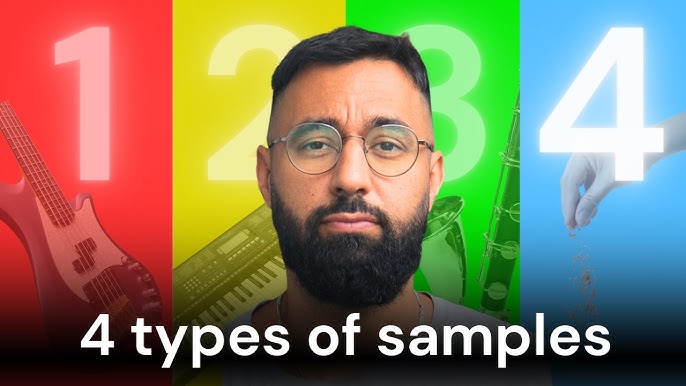
The Four Sample Roles and How to Use them
In his latest video, Boom Bap producer and prolific YouTuber Navie D breaks down the different roles that samples play in sample-based music production. Using the analogy of a movie production, he identifies four key jobs that samples play in the creation of a beat. He then shows how understanding these roles can help you craft stronger, more intentional tracks.
So first, let’s break down the four different sample roles according to Navie D…
Sample Role 1: The Star

The star sample is the central focal point of your beat. It is the element that defines the track’s identity and gives it its unique character. It’s the sound that immediately captures the listener’s attention, often leaving a lasting impression that makes the beat memorable. Typically, the star sample features a strong melodic or harmonic idea that listeners can hum, whistle, or recognise instantly.
Beyond just being catchy, the star sample guides the mood and direction of your production. Its tonal quality, rhythm, and emotional weight often dictate how you arrange supporting elements around it. If you were to remove the star sample, the beat would lose much of its personality and impact, highlighting just how crucial this choice is.
Selecting the right star sample is therefore one of the most important creative decisions in sample-based production. Producers often spend hours searching for a sample that not only stands out but also interacts effectively with other layers, harmonically and rhythmically, ensuring the entire track feels cohesive and intentional.
Sample Role 2: The Support
The support sample doesn’t aim to grab the listener’s attention right away. Instead, its purpose is to reinforce and complement the star sample, adding depth and cohesion to the overall composition. A support sample can come from a completely different source or even from the same record, sample pack, or construction kit as the star.
These samples often provide counter-melodies, harmonic layers, or rhythmic elements such as a rhythm guitar loop or a subtle piano riff. The purpose is to enhance the main idea without competing for the spotlight. Their role is to thicken the texture, create a sense of movement, and add musical interest while letting the star sample shine.
A well-known example is the slowed-down Chubby Checker “Popeye (The Hitchhiker)” sample used in House of Pain’s “Jump Around.” The one-bar arpeggiated piano loop acts as a rhythmic and melodic foundation that supports, rather than overshadows, the iconic horn screech that is undoubtedly the star of the show.
Sample Role 3: The Director

The Director sets the rhythm, structure, and overall flow of a track, providing a solid framework for all the other elements to sit on. In most cases, this role is filled by the drum track. Drums guide the beat, establish the tempo, and define the track’s groove, ensuring that every other element falls into place.
Beyond just keeping time, the way the drums swing, accent, and interact with other instruments heavily influences the feel and energy of the track. Whether you’re looping or chopping a drum break or programming drums from sampled one-shots, they act as the backbone of your beat. Without a strong Director, even the most interesting melodies and samples can feel directionless.
It’s worth noting that not every track requires traditional drums. Ambient or the recent trend of drumless hip-hop, for example, might rely on rhythmic elements embedded in other samples, or may skip percussion altogether, but even then, some rhythmic guide or pulse usually serves the Director’s role in subtle ways.
Sample Role 4: The Background Extra
The background extras are the subtle layers that add depth, personality, and richness to your beat. While they rarely take centre stage, these samples are essential for keeping a track interesting and dynamic, preventing it from feeling flat or repetitive.
Background extras can take many forms. They can present themselves as textures, vocal ad-libs, atmospheric FX, risers, percussive layers, synth pads, horn trills, and more. Producers often use effects like reverb, delay, or subtle modulation on these elements to help them sit perfectly in the mix, so they support the star sample without overpowering it.
A classic example of an expertly used background extra sample can be heard in Mobb Deep’s “Shook Ones Pt. 2.” As the beat unfolds, multiple layers are introduced to build tension and depth. The dramatic, sustained chord sampled from Quincy Jones’s “Heist” OST creates a sense of suspense that perfectly complements the main, pitched-down Herbie Hancock piano loop. Together, these layers create a rich, cinematic feel, showing how carefully chosen background elements can elevate a beat from good to iconic.
Multiple Roles
While Navie D identifies four distinct sample roles, not every beat will fit neatly into this structure. Many tracks may feature only two or three roles, and in some cases, a single sample can serve multiple functions at once. For example, the star sample can sometimes double as the Director, particularly when a drum sample has strong character and forms the basis of the track. A prime example is Dizzee Rascal’s “Fix Up, Look Sharp,” where the Billy Squier “The Big Beat” drum break dominates the production, acting as both the rhythmic backbone and the central focus. Vocal samples from the same break then play a supporting role, reinforcing the powerful drum-driven groove.

Similarly, the main star sample can fulfil several roles simultaneously, especially when using a full sample that contains multiple elements, like melody, harmony, and rhythm. A notable case is Wu-Tang Clan’s “C.R.E.A.M.”, which samples The Charmels’ “As Long As I’ve Got You.” Here, the sample provides the catchy piano riff, the underlying chord progression, and even the drum hits, which producer RZA subtly layers to form the track’s full foundation.
This demonstrates that the four-sample-role framework is not a rigid formula. Rather, it is a practical analytical theory that helps producers and listeners understand how different elements interact in sample-based music, providing a structured way to break down, study, and ultimately improve your own beats.
Using these Principles in your own Production
Understanding these four sample roles can be a useful tool for improving your beatmaking workflow. One of the most immediate benefits is in the sample hunting process. When you come across a sound that inspires you, it’s helpful to consider what role it might play in your track. A sample with a strong melody or unique tonal character is likely suited for the star role, which means it should take centre stage. Once you identify a potential star sample, avoid looking for competing elements that might distract from it. Instead, think about finding supporting samples. Whether lush guitar chords, some rich strings or a characterful synth arpeggio. And these roles dont have to be samples. All 4 roles can be interchanged using Virtual Instruments.
These principles can also encourage alternative workflows. Many producers naturally start with a star sample and build the beat around it, but experimenting with a different approach can spark creativity. For instance, you could start with the Director and create a drum pattern or rhythm section. Then build your melodic and harmonic elements on top. This can result in beats with a strong, organic groove, and you can always swap or layer different drum sounds once the track takes shape.
Thinking about your beat in terms of sample roles also helps you analyse, refine and finish your tracks. If a beat feels incomplete or lacking direction, breaking it down into Star, Support, Director, and Background Extras can highlight what’s missing or underdeveloped. It provides you with a clear framework for purposefully adding elements, rather than just layering sounds at random.
One important consideration that wasn’t touched upon in the video is creating a role and space for vocals or other solo instrumentation. If you’re planning to add a vocalist, avoid overloading the track with too many competing layers. Think of the vocals as a “special guest star”. Your beat should support them while still retaining its own identity. By keeping the roles in mind, you can craft a track that is dynamic, balanced, and ready for collaboration.
Ultimately, these principles are not strict rules, but a flexible framework. They help you understand the purpose of each element. They can guide your creative decisions and inspire new ideas to transform a simple loop into a fully realised, polished beat.
For a visual demonstration of these concepts, check out Navie D’s video below.
And if you are looking for Beats or Samples for your next project then RouteNote Create has you covered. sign-up now and take your music to the next level