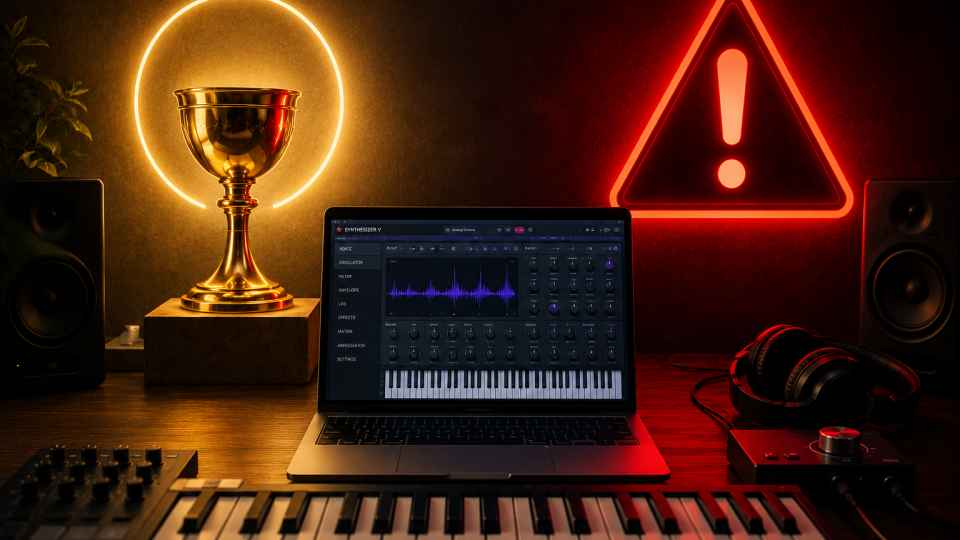
AI powered production tools: Holy grail or potential fail?
Year on year, AI is becoming more and more a part of modern music production workflows. But is this constant march towards AI powered music creation a positive development or a shortcut that could do more harm than good? With opinions very much divided and polarised we look at the pro’s and con’s of AI use in music production.
What we will be discussing
Before we begin, it’s important to define exactly what we’ll be discussing here.
This article is not about text-to-music generative AI where fully formed tracks are produced from simple prompts. That’s a completely different debate for another day.
Instead, we’re focusing on AI-powered production tools that still leave the producer in control of the creative process. This includes technologies such as AI-generated vocals, sample creation, sound design, melody generation, stem separation, mixing and mastering assistants. In these scenarios, AI functions more as a creative collaborator than a replacement for the producer.
We’ll also focus specifically on genuine AI technologies that utilise machine learning and large language models, rather than software that simply adopts the term “AI” as a marketing buzzword while relying on traditional algorithms and processing techniques.
Like most emerging technologies, AI brings with it both exciting opportunities and valid concerns. And it’s this balance that we will be examining and discussing in this article. So strap yourself in as we take an objective look at both sides of the AI argument.
The positives of AI-powered production tools
As the range of AI-powered production tools continues to expand, we’ll break down the aspects currently affecting modern music production. For each category we will explore how AI tools are assisting the creative process.
Access to sounds and performers you couldn’t otherwise afford

For many aspiring producers and beat makers, it’s not always easy accessing professional performers. Hiring vocalists and session musicians can be an expensive business that often requires the use of professional recording facilities. AI-powered vocal generators such as Synthesizer V, ACE Studio and Audimee can produce convincing performances without the need to book a professional.
The way these powerful tools work varies. Some, like the well established Vocaloid allow you to input a melody and lyrics as text. The software then reproduces this as a vocal performance. Tools such as Audimee on the other hand work in real time. You record in your own vocal performance and Audimee automatically changes it in real time to one of it’s own library of vocalists. So with both of these techniques you are providing the tools with all of the creative input, from the melody to the lyrics. You also have the option to further shape the AI performances with things like vibrato and attitude.
And while AI-assisted instrument modelling tools are not as well established as their vocal equivalents, they are starting to show great promise. Ace Studios is currently a pioneer in this field. It allows you to input your own midi notes and then apply one of it’s modelled instruments. It uses the MIDI information to interpret how a musician may approach that performance and it produces AI audio based on this. This is a totally new form of synthesis and has the potential to totally transform the way producers can create realistic sounding instrumentation. While Ace Studio currently only offer a limited range of instruments the results are impressive to say the least. It is possible in some cases to make sample based instruments sound this realistic but it often involves skilful and time consuming use of articulations and articulations.
While tools like these are unlikely to ever replace the magic of a talented performer, they can provide a practical solution when resources are limited.
A game changer for sample creation
One of the most obvious uses of AI is as a sample generator
For decades, producers have sampled from old obscure records and vintage recordings. The problem with this approach is copyright. Producers can easily experience legal and licensing complications as well as distribution difficulties. As a result, royalty-free samples created specifically for music production have become the preferred and safest option for many artists.
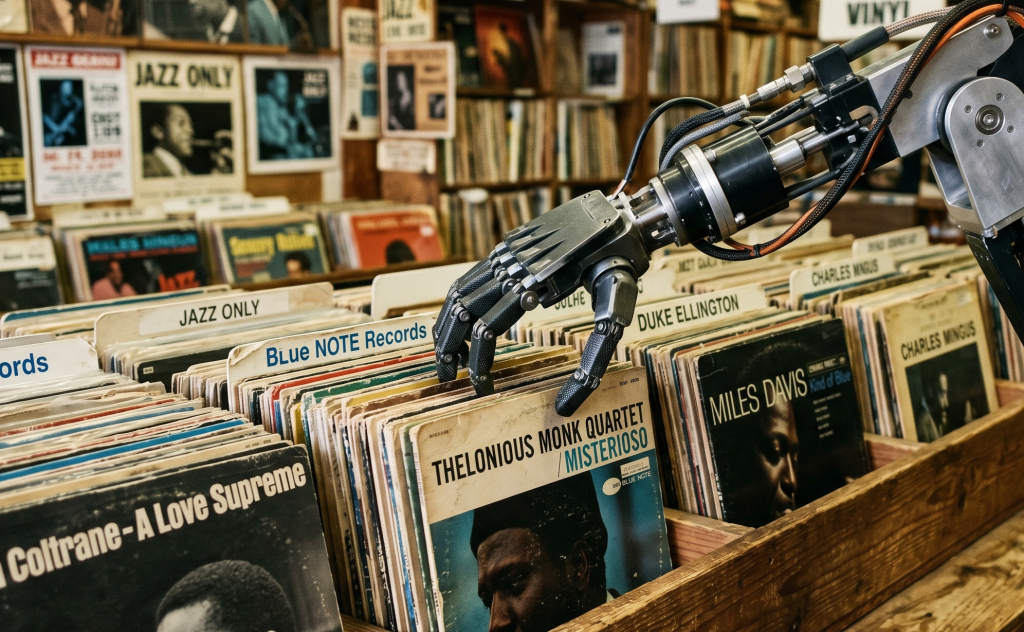
AI-powered sample generation tools offer an alternative solution. Platforms such as Output Co-Producer, Google MusicFX, Stability AI’s Stable Audio and various emerging tools help producers generate entirely new source material to sample from. You can use prompts and guides to engineer the sort of sounds you’re after. Imagine generating dusty jazz-inspired grooves, vintage soul chords or old film soundtrack atmospheres without the need to clear a sample.
This technology is still pretty random and its generally difficult to create the exact sounds you have in your head. But if you are willing to be inspired by the samples that are generated then this is a useful tool.
And while you don’t need to clear these samples in the traditional sense you should always study the user agreements as there may be limitations to the sample usage.
The future of custom synthesis
Synthesizers have evolved massively over the past few decades since computer based production. Some believe AI could represent the next major leap forward.
Companies are beginning to experiment with AI-assisted sound design that can generate patches based on descriptions, references or target sounds. So instead of spending hours tweaking oscillators and modulation settings, producers can simply point the AI in the direction of the sound they’re imagining.
Tools such as Synplant 2 by Sonic Charge already use AI-assisted technology to generate entirely new sounds from simple seed inputs. And as these technologies mature and are adopted by more developers, sound design and synthesis has the potential to become faster, more intuitive and more accessible.
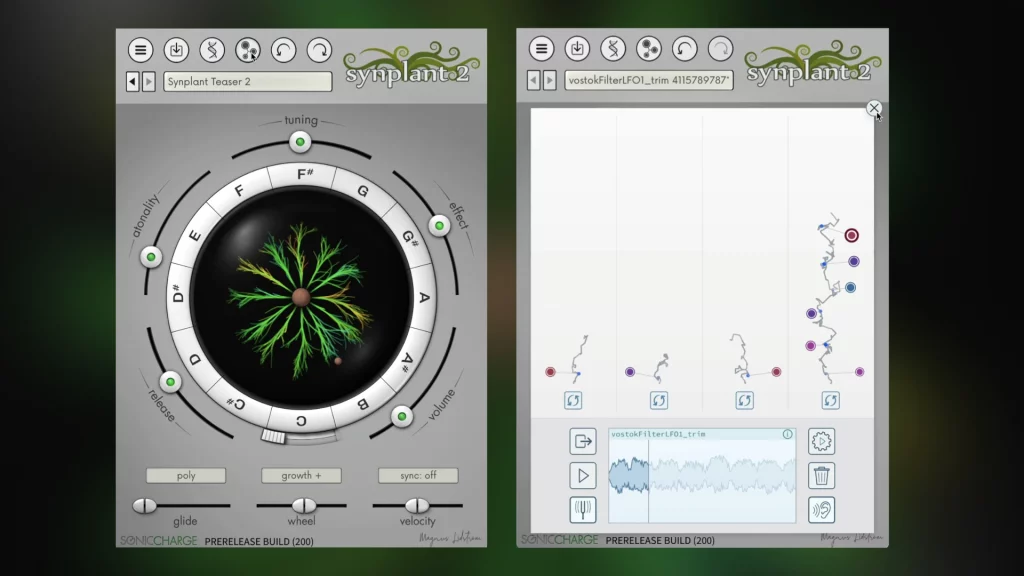
This approach places you fully in the driving seat because the results are inspired by your personal instructions. You have the potential to therefore shape your creative vision into a reality.
AI Mixing and Mastering Assistance
Mixing and mastering is a skill that can take years to master. This is where AI-powered processing tools have become particularly useful.
Products such as iZotope Ozone, iZotope Neutron, Sonible smart and LANDR use machine learning to analyse audio and suggest improvements. They can act as your ears, automatically identifying frequency imbalances, optimising loudness and providing useful starting points for a mix or master.
Will they replace an experienced engineer? Probably not, but they do provide a fast way to instantly bring balance to a mix and provide a good starting point. They can certainly help newer producers achieve cleaner, more polished results.
And since most music listeners see mixing as a technical skill rather than a primary form of artistic expression, AI assistance in this area is typically met with far less resistance than AI involvement in songwriting, production, vocals, or performance.
AI powered Stem separation is already well established
We have covered plenty of stem separators on this blog over the years. They are perhaps one of the most universally praised and accepted AI tools available to producers. Software such as Serato Sample, RipX, LALAL.AI and Moises can separate elements such as vocals, drums, bass and instruments from full mixes with surprising accuracy. For remixers, DJs, producers and sample based creators, this technology opens up enormous possibilities.
And like mixing AI tools, stem separators don’t attempt to “create” something unique. Instead stem separation can offer exciting new opportunities, unlocking creative avenues that simply weren’t possible before this technology existed.
The Negatives of AI-Powered Production Tools
Public Opinion Remains Divided
Despite the numerous exciting benefits, AI still carries a significant stigma within parts of the music community and with many music fans. Like so many aspects of modern life it’s a hugely polarising subject with harsh criticism of ANY use of AI in creative applications such as music.

Many artists and listeners view AI-assisted music as inauthentic, or see its use as a shortcut that undermines creativity. Even when AI is being used purely as a production tool, as discussed throughout this article, some audiences remain sceptical. The reality that AI exists on a spectrum, ranging from subtle assistance to complete automation, is often overlooked in favour of a more black-and-white viewpoint that leaves little room for nuance.
I recently tested this perception here at RouteNote HQ, a workplace filled with musicians, producers, and passionate music fans. I presented an example of AI being used to create realistic orchestral and choir patches based on MIDI data written entirely by the producer. Despite the producer retaining full control over the notes, chords, arrangement, and composition, the reaction was overwhelmingly negative, with only a handful of people defending the technology’s use.
This backlash towards AI creates an unusual situation where producers may benefit from AI-powered tools behind the scenes but choose not to openly admit to using it. Whether this perception changes over time remains to be seen.
Sound quality can be questionable
Although AI technology is always improving there tends to be a very specific ‘sound’ to AI generated music and audio. While some examples deliver better results than others, to the trained ear there’s generally a slight fuzziness, unusual phasing, or a lack of the depth and realism found in traditionally produced recordings. In most cases fully AI-generated audio still struggles to match the sonic quality of a professionally produced and mixed track.
For example, some AI-generated vocals can sound unnatural or lack the nuances of a real performance, Especially if they have been generated from text and MIDI prompts. AI-generated samples may contain odd artefacts or arrangements that don’t quite feel authentic. Stem separation tools are often the most obvious offenders. While the technology is incredibly impressive and useful, they frequently leave behind remnants of other instruments, unwanted noise, or audible artefacts. Compare an AI-separated stem with an original multitrack stem and the difference in quality is going to be quite noticeable.
As a result, many producers find that AI-generated content still requires significant editing, processing, and refinement before it is ready for a commercial release.
AI-powered mixing and mastering tools tend to avoid many of these issues because they are processing existing audio rather than generating new material. However, they aren’t flawless. Some AI-driven processing can be overly aggressive. This can lead to mixes that feel over-compressed, over-EQ’d, or lacking in subtlety. Ultimately, no matter how advanced the software becomes, the human ear should always remain the final judge.
AI is replacing creativity
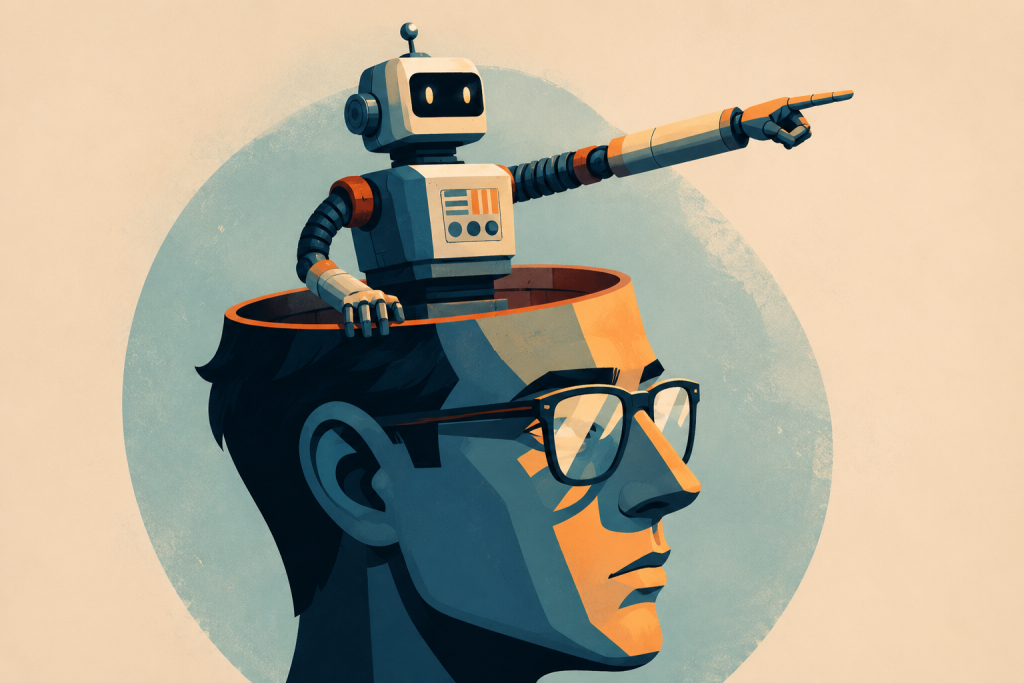
One of the biggest criticisms of AI is that it could encourage creative shortcuts.
Becoming a great producer has always been about developing your ear, experimenting with sounds and solving creative problems. If AI begins to make too many decisions on your behalf, those skills may not develop as fully.
The concern isn’t necessarily that AI creates bad music, although that is a concern of many. It’s that producers may become overly reliant on suggestions, automated workflows, presets and AI inspired creative decisions instead of developing their own artistic identity.
This argument was only fuelled further by comments from Suno CEO Mikey Shulman. He sparked widespread backlash when discussing the role of AI in music creation. In an interview, he stated: “I think the majority of people don’t enjoy the majority of the time they spend making music.” He also described music creation as something that is “not really enjoyable” because it requires time, practice, and skill development.
For many musicians and producers, these comments highlighted exactly why concerns about AI replacing creativity exist in the first place. After all, much of the creative value of making music comes from the experimentation, learning, problem-solving, and personal expression. If AI is viewed as a way to bypass these processs’s entirely, it inevitably raises questions about what is being gained, and what might be lost.
Take important production skills for example. Creating realistic instrument performances can involve the use of many articulations and volume automation. if AI tools such as Ace studios decide how an instrument sounds when it is played we end up loosing the ability to shape performances to our own liking.
In summary this argument depends largely on how the producer chooses to use the technology. If a producer already has a clear creative vision and simply uses AI as a tool to help realise that idea, the impact on creativity is minimal.
Genuine talent may struggle to stand out
As AI tools become more accessible, the volume of music being released continues to grow exponentially. While the vast majority of this is fully text prompted, it’s likely that more and more ‘original’ music will incorporate elements of AI as an aid to creation.
When anyone can generate vocals, melodies, samples and arrangements within minutes, distinguishing between exceptional talent and AI becomes increasingly difficult. And if record labels start to adopt and approve of AI as an acceptable tool then where does this leave the music industry?
The producer Timbaland, who is arguably regarded as one of the most influential and creative producers in Hip-Hop and pop has come under repeated fire for his support of AI. In particular his signing of an AI artist: TaTa. Many argue that labels will eventually favour working with AI artists and musicians as they wont have the same demands as a real human.
Copyright and ownership concerns
The speed and pace of development in AI technology has meant copyright law is still catching up with it.
Depending on the platform and jurisdiction, tracks containing substantial AI-generated vocals, samples or musical content may face additional scrutiny regarding ownership and copyright protection. Distribution platforms, collecting societies and copyright offices continue to update their policies as the technology evolves. Currently, for example, most digital music distributors will not send AI music to content ID stores such as YouTube.
Some platforms such as Dezzer already claim to have implemented automatic AI detection tools. These aim to choke and restrict the visibility of AI content on their platform so real music can be prioritised. To what extent it can detect AI music is however questionable and unclear. There is always the risk that as detection improves it will also pick up music that simply uses AI tools in the creation process rather than just prompt driven tracks. For example a track that uses AI samples or vocals.
This ever evolving situation makes it difficult to predict how your music could be effected in the future.
As a producer using these tools, it’s therefore important to understand the licensing terms of every AI product you use and stay informed about changing regulations.
Ethical questions remain
Finally, there is the ethical argument. This is perhaps the most contentious issue in the AI music debate.
A significant amount of criticism from both artists and fans stems from concerns over how AI models are trained. Because many systems rely on enormous datasets of existing music and audio, questions continue to be raised about whether copyrighted material was used without the knowledge or consent of the original creators. This issue is particularly relevant for tools that generate music, samples or vocals based on existing creative works.

Some companies are addressing these concerns by building licensed and transparent datasets. For example, several specialist AI vocal platforms work directly with singers whose voices are used to train and create AI voice models. In these cases, the performers have given their consent and are compensated for allowing their voices to be replicated and used within the software.
For producers and artist who care deeply about artist rights and ownership it’s always worth researching how an AI model was trained. Check whether the creators whose work contributed to it were properly licensed and compensated.
Conclusion: Grail or fail?
AI-powered production tools are neither a holy grail nor a potential fail. Like any technology, their value depends entirely on how they are used. But as we have highlighted there are still areas of public perception that are not so easy to influence or effect.
Public opinion aside, I think it is fair to argue that treating AI as a tool rather than a replacement for creativity is the way to go. If you’re using stem separation, AI mastering, sample generation or synthesis assistance to support your ideas, these technologies can become powerful and revolutionary additions to your workflow. It’s likely AI will continue to influence the broader developments in music tech to the extent that eventually it may be impossible to avoid using such tools.
Where we currently stand I think it’s important to acknowledge that there is a sliding scale between you being in control and the AI being in control. The more you rely on automation and AI to do the heavy lifting, the more complex the questions become around creativity, originality, ownership, and how the work is perceived by the public.
For aspiring producers and beat makers, the key is balance. Use AI to remove obstacles, speed up repetitive tasks and inspire new possibilities, but don’t allow it to replace the creative instincts that make your music unique and original. Besides, despite SUNO CEO Mikey Shulman’s comments, music making should be fun. And if you are getting AI to take control then you are missing out on the joy that comes from creative musical expression. It is likely that the producers who thrive in the future will be the ones who embrace useful AI innovations while maintaining complete control over their artistic vision.
So as we conclude this article instead of focusing on the future we should maybe look at the past. It’s worth remembering that every major technological shift in music has faced resistance. The rise of synthesizers in the 1970s, drum machines in the early 1980s, and sampling in the late 1980s and early 1990s were all met with scepticism, controversy, and uncertainty.
In each case, public opinion was divided and regulations struggled to keep pace with innovation. Yet over time these technologies became accepted parts of the musical landscape and helped shape entire genres. AI may follow a similar path, so looking back at these previous revolutions could provide some clues as to where the current debate is heading.
And if you are looking for Beats or Samples for your next project then RouteNote Create has you covered.
Sign-up now and take your music to the next level